
How Rising Freight Costs Impact Farmers and Everyday Australians
Freight has always been a major farm cost. In 2026, the Iran-US conflict made it much bigger. As the Iran-US war continued to drag on beyond expectations, its impact was felt across all business sectors and everyday life too. Farmers are the cornerstones of the Australian economy, and their woes become a challenge for everyone. As fuel prices are high across the globe, a petrol/diesel importer such as Australia couldn’t stay aloof from the impact of the higher fuel prices.
This stress is particularly visible in the farm sector and everyday life of the common Australian people. In Australia, farms are located away from the towns, and therefore, crops grown have to be transported across the country where they are required. The freight costs are an additional operational cost for the farmers. With fuel prices surging to their highest level in 2026, farmers have to bear higher freight costs not only to transport their ‘produce’ but also to fetch ‘fertilisers’ and ‘agricultural equipment’.
In this article, we will discuss how rising freight costs are squeezing Australian farmers’ profit margins and increasing consumer retail inflation (as a consequence of higher food prices) for Australia’s general public.
What is Actually Driving Freight Costs Up in 2026?
Freight costs in Australia are being driven by these three main culprits:
- Fuel Prices
- Tax Increases
- Shipping Costs
1. Increased Fuel Prices Shock Felt Across Farm Supply Chain
The Australian Institute of Petroleum recorded a national average diesel price for the week ended on 20th September 2026. AIP data shows the national average diesel hit 273.6 cents per litre in the week to 20 September 2026.
Below are the prices:
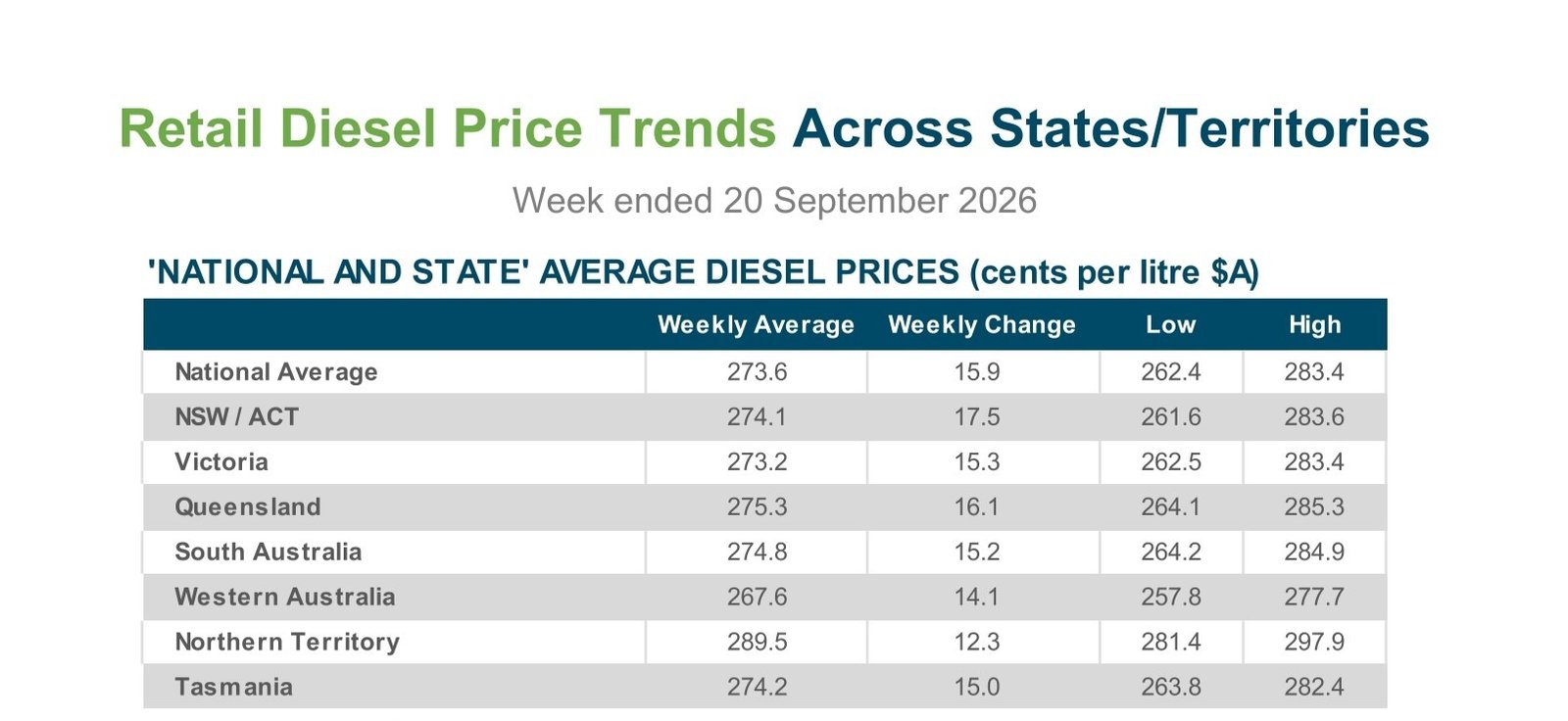
The prices have increased drastically since the Iran-US war began. The impact of the Iran-US war is adverse on fuel prices, which have surged abnormally.
The CEO of the Australian Food and Grocery Council (AFGC), Colm Maguire, states that the pressures felt due to increased Brent crude prices are being extensively felt across the supply chains. He states that it is an unprecedented shift and has effects far beyond a temporary logistics bottleneck.
From fertilisers to freight trucks to electricity supply, every component of the supply chain is expensive. Urea prices were up 67% year on year to March 2026.
As per AFGC, Wheat rose 8% year on year and 11% between February and March 2026.
2. Tax Relief Ended
The Australian Federal Government stepped in with temporary fuel excise relief. Between 1 April and 30 June 2026, fuel excise dropped from 52.6 to 20.6 cents per litre, and the Heavy Vehicle Road User Charge (RUC) was cut to zero. From 1 July to 2 August, 2026, the RUC was 16.4 cents per litre. It reverted to 32.4 cents per litre on 3rd August 2026.
Without Tax relief, the fuel price increases are totally borne by the logistics and transport industry and the general public.
3. Shipping Costs of Agricultural Produce
Australia’s agricultural shipping costs are linked with road freight and rail freight needed to transport the produce to different states and cities. This is where the numbers stop being abstract. Australian Livestock and Rural Transportors Association estimates that agriculture-linked road freight consumes between 1.5 billion and 2.5 billion litres of diesel every year.
At that volume, a minor change of a few cents in diesel prices can cause millions of dollars in extra costs to farmers and ultimately Australian consumers.
How Rising Freight Costs Affect the Farmers
Agricultural freight is mostly one-directional; it is costly. Often the drivers return empty. Secondly, while the agricultural produce takes more trucking space, its value is low. So, farmers have to spend significant freight costs compared to the value of the goods they are transporting.
- CSIRO TranSIT modelling cited by GrainGrowers found that transport costs the Australian grain industry $2.1 billion per annum.
- What is interesting is to note that transport costs are between 4 and 48.5% of farmgate value (the price farmers receive for their crops).
All combined, the farmers are being affected by fuel prices, fertiliser prices, and freight prices. The margin squeeze they are experiencing is sometimes passed to end consumers, and it affects retail prices, but many a time the brunt is borne by the farmers themselves.
Farmers do not hold complete control over the prices at which their produce is sold in the market, as other factors such as demand, supply, competition, and the nature of the market all determine the maximum final price the producer may receive.
Hence, it is not always possible to pass on the burden to the final consumer and keep enjoying the same profit margins despite changes in cost.
The agriculture industry many times has to absorb the increase in cost, leading to a lower margin, which over 1-2 transits may seem insignificant, but over time, as the number of transits increases, it has a serious impact on the profitability for the farmer.
The impact is real. As per the data from the Australian Bureau of Statistics, the agriculture industry saw only a 0.2% quarterly growth in the June quarter of 2026.

Did You Know?
Refrigerated freight is one of the most fuel-exposed freight in the country. The reefer unit needs more diesel than normal trucks. The cold-chain-based farmers involved in dairy products whose transport needs specialised refrigerated trucks are feeling the impact of the higher freight costs.
Perishables cannot wait for a better freight rate. This is exactly why temperature-controlled transport with disciplined scheduling and reliable cut-off times matters more when fuel is expensive.
How Farm Freight Costs Reach the Average Australian Household?
For farmers, transportation is an essential part of getting their produce to the consumer, but as the cost of moving goods is increasing, it is putting additional pressure on everyone involved.
As we have discussed, freight costs are a high operational cost for the agriculture and livestock industry; even a slight rise causes an impact on the margins. The supermarket shelf that you see includes those costs in the final product prices.
There are several components that make up the final price of an item in the supermarket, but one undeniably important element of the price is the freight cost, which simply cannot be ignored.
In a vast country like Australia, where every item needs to travel thousands of kilometers before reaching its final destination, the more it travels, the more crucial freight becomes as an element of the final price.
What Can Farmers Do About Freight Costs Right Now?
Freight prices are something that no one can control, but what is under control is freight management. With efficient freight management, farmers can minimise, if not completely mitigate, the effects of fuel rises.
Here are the suggestions to help farmers minimise their freight costs:
- Plan loads to combine all your compatible goods to save space. For instance, consolidate loose cartons into palletised freight. Building freight onto pallets and booking cost-effective pallet or general freight services lowers the costs.
- Oversized cartons and poor palletisation mean you are paying more. Professional packaging services that optimise the cubic weight of your produce can significantly lower the space-related freight charges.
- Move from regular rates to contract rates. Contract transport services offered by professional freight providers keep your freight costs lower, as you get discounted base rates. This will mitigate the impact of fuel price increases, as your freight is already delivered at lower rates than casual loads. So, any increase in fuel price is offset by the discounts you get in base prices.
- Put your freight with services that are extensive and have coverage from local to national. This means that you have a chance to save on return empty journeys.
- Position inventory closer to market. Holding buffer stock in a warehousing and 3PL facility near your customer base lets you ship on a planned schedule.
Bottom Line
When freight costs rise, the effect does not stay on the farm. It travels through distributors and retailers to the end consumers. Farmers are the first ones to feel the shock of rising fuel and freight prices. Rising costs are continuously creating challenges for the Australian supply chain and farmers, so steps need to be taken to effectively manage their impact.
While global oil markets are under no one’s control, proactive measures such as those explained in this article can help reduce the impact of rising freight prices.
If rising freight costs are eating into your margin, the fastest saving available is usually not a cheaper carrier. It is a better-structured freight operation.
Soldrift works with farmers, growers, producers, agribusinesses and regional operators across Australia to do exactly that.
Get in touch here or request a quote to save on freight prices.

Jade Williams
CEO & COO at Soldrift
Leading our team with a focus on growth and operational excellence.